Tag Archives: jesus
I need a Savior


How important is planning? or Should a Christian Plan for the Future?
…Before your head hits the pillow…
How important is planning? or Should a Christian Plan for the Future?
Many of you may remember the Doris Day song, Que Sera, Sera, whatever will be will be. The future’s not ours to see, Que Sera, Sera. I know of Christians who live this way. They believe that investing in their future shows a lack of faith. They say that God will supply all of their needs so there is no reason to make plans, no reason to invest in the future.
Does planning for the future show a lack of faith. Does working hard, making a good living, saving and investing for the future of your family show that you don’t believe that God will take care of you?
Matthew 6:19-20 say, “Do not store up for yourselves treasures on earth, where moth and rust destroy, and where thieves break in and steal. But store up for yourselves treasures in heaven, where neither moth nor rust destroys, and where thieves do not break in or steal;…
Matthew 6:28 says, “And who of you by being worried can add a single hour to his life? And why are you worried about clothing? Observe how the lilies of the field grow; they do not toil nor do they spin, yet I say to you that not even Solomon in all his glory clothed himself like one of these.”
And Matthew 6:26 says, “Look at the birds of the air; they do not sow or reap or store away in barns, and yet your heavenly Father feeds them. Are you not much more valuable than they?”
People often use these verses to say that planning for the future does show a lack of faith. That Que, Sera, Sera should be our motto. Trust in God, whatever will be will be. I believe this is wrong thinking.
Proverbs 21:5 tells us just the opposite. “The plans of the diligent lead surely to plenty, but those of everyone who is hasty, surely to poverty.”
Vic Williams in the September 12th writing of InHisFootsteps.com in an article entitled: Should Christians Plan or Simply Trust God? says this “The phrase ‘the plans of the diligent’ is an interesting phrase as the word translated here as ‘plans’ comes from the Hebrew words ‘machashabah machashebeth’ which can be translated as thoughts, intentions, advice, imaginations or purpose. The word diligent could also be translated as incisive, determined or eager. We could therefore read this verse of scripture as, ‘The thoughts, advice, intentions, purposes and plans of the incisive, determined, eager and diligent lead to plenty.”
We shouldn’t JUST plan for the future, we should be deliberate and intentional in our plans. We need to look at what God has for us to do and make plans to fulfill that purpose.
I was struck while reading I Chronicles 22 how David planned for the building of the temple. God had told David that he was not to build the temple, he had killed too many in battle. David’s son Solomon was to build the temple. But David didn’t just say, “Oh, okay, I will leave that up to my son, if that is what God wants.” No he made PLANS to help his son’s efforts. Although David was not to build the temple he could still plan for its building so he gathered iron for the nails and more bronze than could be weighed. He gathered nearly 4,000 tons of gold and 40,000 tons of silver. He also gathered timber and stones for the walls. Before he died he ordered all of the leaders of Israel to help Solomon build the temple. David planned.
Paul made plans in Acts 15:36 and in Romans 1:13. The apostles made plans in Acts 6:1-3
Proverbs 6:6-8 says, “Go to the ant, you sluggard; consider its ways and be wise! It has not commander, no overseer or ruler, yet it stores its provisions in summer and gathers its food at harvest.
Yes, not only should we plan for the future, we MUST plan for the future. Planning is wise. But we must make sure that all of our plans are covered with prayer and a petition for God’s will to be done in our lives. If we are storing up things on this earth as a replacement for honoring God, these plans will lead to nothing but destruction.
Vic Williams ended his writing with these words and I think they are a good way to end this writing of mine, “Planning for the future, with prayerful consideration is good for you and your family. It is Biblical. It shows faith and trust and it establishes your commitment to do what God has directed you to do. Plan diligently, act purposefully, and live abundantly.”

Are You Heaven Bound?
Early this morning I posted a meme that made comments about what would NOT get you into heaven and what WOULD get you into heaven. The comments that ensued were interesting. Very rarely have I posted anything that caused this much conversation.
First let me say that no meme or no single post that I place on this page will contain in it all of Biblical doctrine. I post memes and writings that I hope will challenge you, encourage you, teach you, bring your joy, or make you think. This one certainly did many of those things.
But since this little meme caused such a stir, I thought that I should write about this topic tonight. So here goes.
Good works will NOT get you into heaven. You can be the best philanthropist who ever lived and it will not help you walk through the gates of heaven. Only trust in Jesus as your Savior will do that. But we must know that good works are a requirement in the life of a Christian. Ephesians 2:10 tells us, “For we are his workmanship, created in Christ Jesus for good works, which God prepared beforehand, that we should walk in them.” And James 2:14-17 says, “What good is it, my brothers, if someone says he has faith but does not have works? Can that faith save him? If a brother or sister is poorly clothed and lacking in daily food, and one of you says to them, “Go in peace, be warmed and filled,” without giving them the things needed for the body, what good is that? So also faith by itself, if it does not have works, is dead.”
Faith and trust in Jesus DEMANDS good works, for to this we were created.
Merely being baptized will not get you into heaven. Many are baptized as children. Just because your parents baptized you does not mean you gain automatic entrance into heaven. Others were baptized as adults and I would say it is fair to assume that even some who are baptized as adults do not really know Jesus as their Savior. So baptism in and of itself will NOT get you into heaven. But that does not mean that baptism is unimportant. Mark 16:16 says,”Whoever believes and is baptized will be saved, but whoever does not believe will be condemned.” Baptism or profession of one’s faith is an outward expression of an inward commitment to the Lord. This passage however, should not be construed to say that if a person is not physically baptized that they cannot be saved. The second part of Mark 16:16 says that whoever does not BELIEVE will be condemned. If you are a true believe then you have received the baptism of the Holy Spirit and it is this baptism that is necessary for salvation. No one can believe without the Holy Spirit working in their lives.
Attending church, mass, or Sunday school will not get us into heaven. For many people sit in church pews or at mass every week who have not met and believed in their hearts in the risen Savior. But does that mean that worshiping together is not important? Quite the contrary. Hebrew 10:24-25 speaks of this when it tells us this, “and let us consider how to stimulate one another to love and good deeds, not forsaking our own assembling together, as is the habit of some, but encouraging one another; and all the more as you see the day drawing near.” So, although going to church will not save us, we are instructed to assemble together to stimulate one another to love each other and to reach out to those in need.
Giving money and doing charity work will not get us into heaven. No matter how much you do or how much you give you will never be able to give enough to gain entrance into heaven. Only trust in Jesus as your Savior will do that. But does that mean tithing and charity work are unimportant. No, not at all! 2 Corinthians 9:7 instructs us, “Each one must give as he has decided in his heart, not reluctantly or under compulsion, for God loves a cheerful giver.” That is giving of our time, our treasure, and our talents.
Will taking communion get you to heaven? NO! Only believing in Jesus as your Savior can do that! But I Corinthians 11:26 says, “For as often as you eat this bread and drink the cup, you proclaim the Lord’s death until he comes.” So although taking communion will not save us it does play a vital part in reminding us of the immense sacrifice that was given to pay the debt for our sins.
Will belonging to a particular denomination or political party get you into heaven? Absolutely NOT!! No denomination, political party, or friendship is without stain, without sin. Each party has its flaws and each denomination has its flaws. Let’s not get so high and mighty about our affiliations that we start feeling better of ourselves just because of who we associate with. Only faith and trust in Jesus Christ can bring about salvation which gives us the reward of eternity in heaven.
And positive thinking will not get us into heaven. Many of today’s modern churches will teach and preach the power of positive thinking. This positive thinking can NEVER get us into heaven. But God loves us and God created us in His image so we should not fail to see ourselves in that way. If we have accepted Jesus as our Savior, we are not only created in the image of the Almighty God, but we are also now called children of God! What a blessing that is.
So nothing listed in the grouping of what will get you into heaven is bad, but rather most are good, and even commanded. But none of them alone with get you into heaven.
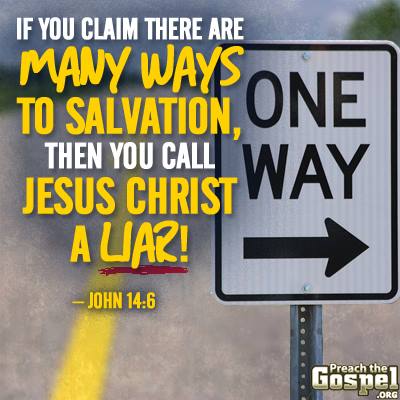
There is ONLY ONE WAY to heaven. Believe in the Lord Jesus Christ and you will be saved. Acts 16:31. John 14:6 further states, “Jesus said to him, “I am the way, and the truth, and the life. No one comes to the Father except through me.” John 3:16 says, “For God so loved the world, that he gave his only Son, that whoever believes in him should not perish but have eternal life.”
And Acts 4:12 says this about Jesus, “And there is salvation in no one else, for there is no other name under heaven given among men by which we must be saved.”
So what will get you into heaven? Only faith and trust that Jesus Christ, God Himself, came to earth, lived among men, never sinned, was tortured and sent to the cross to pay the penalty for our sins, for the sins of all who believe in Him. And that three days later, He rose from the grave and smashed death to smithereens. He now reigns at the right hand of God the Father and will one day return to earth to bring about a new heaven and a new earth where we will live eternally with Him in Glory! WOW!! What a Savior!!

Tricking Jesus
…Before your head hits the pillow…
Tricking Jesus
The Pharisees and Sadducees were constantly trying to trick and trap Jesus. The Pharisees were primarily business class individuals and were viewed in high esteem by the Jewish people. They believed that the Old Testament was the inspired word of God but they also ascribed to many other more traditional laws which were written in the Mishnah as passed on orally from one generation to the next.
The Sadducees were wealthy and more distant from the people. They believed that the Old Testament was inspired and did not believe that oral tradition had equal authority to scripture. The Sadducees didn’t believe in the spiritual realm of angels and demons or an afterlife but the Pharisees did.
But both groups saw Jesus as a threat to their authority and spent much time trying to determine a way to get rid of Him.
In Mark 12 the Pharisees tried to trick Jesus when they asked Him if it was all right to pay taxes to Rome. They believed that if He said no, the Roman government would arrest Him. If He merely said yes it would appear that He was a Roman sympathizer and the people would turn against Him. But Jesus was and is wise. What He told them was to look at the coin. The coin had on it the image of Caesar. He told them to pay to Caesar that which was Caesars and to God that which was Gods.
Later in the same chapter the Sadducees took their turn at trying to trick Jesus. They asked him a really ridiculous question considering they did not believe in the afterlife. They asked Him about a woman who was widowed 7 times. When she got to heaven, whose wife would she be? Jesus was again just too wise for them. He told them that she would be no man’s wife for there is no marriage in heaven. But He didn’t stop there. He then quoted Exodus 3:6 the scripture referencing the burning bush. It states, “I am the God of your ancestors – the God of Abraham, the God of Isaac, and the God of Jacob.” Jesus told them that He wasn’t the God of the dead but the God of the living so Abraham, Isaac and Jacob MUST be alive for God to be their God AFTER they had died.
In John 10 the Pharisees were up to their trickery as well. Divorce was a tricky subject and Moses had given the people of Israel an out. They wanted to see if Jesus too would readily condone divorce. But Jesus in His wisdom schooled them once again. He let them know that Moses had written his instructions about divorce only to please the hard hearted wickedness of the people, but God ordained that marriage should be forever.
We have a very wise and powerful God. Jesus knows all and understands all. He knew when the Pharisees and Sadducees were trying to trick Him and he knows when we are trying to evade Him or control our own lives.
When we try to trick Jesus by bargaining with Him, he knows our hearts. When we bargain with Jesus saying, “If you will do this, then I will do this,” Jesus sees into our hearts and knows that with that bargain our hearts are not completely surrendered to Him.
Just as the Pharisees could not trick Jesus, we will never be able to trick God either. If we are living a life of faulty service and worship, He knows. If we attend church and go through all of the ritualistic motions of being a Christian but have never really accepted Him as our Savior and Lord, He knows.
If we have deep hidden sins, we must know they are not hidden from Him for He knows our hearts. There is nowhere that we can go to hide from God. There is nothing we can do to trick Him into believing that we are something that we are not.
Jeremiah 23:24 says, “Who can hide in secret places so that I cannot see them?” declares the LORD. “Do not I fill heaven and earth?” declares the LORD.” And Psalm 139:7 tells us, “Where can I go from your Spirit? Where can I flee from your presence?” And again in Hebrews 4:13 we read, “Nothing in all creation is hidden from God’s sight. Everything is uncovered and laid bare before the eyes of him to whom we must give account.”
God is all knowing and all powerful. The Sadducees and Pharisees couldn’t put one over on Jesus and neither can we. So if today we have unconfessed sins, let’s go before the Lord and confess them. If we have been living a spiritual life riddled with ritual but not filled with the Spirit of God, Let’s fall on our knees and confess Him as Lord. Let’s ask Him to mold us and make us into a new creature, one created to worship and glorify Him! No more hiding, no more bargaining, no more trickery, just sincere worship. That’s what God wants. Let’s give it to Him!

What does it mean to judge, or what does the Bible say about judging?
…Before your head hits the pillow…
What does it mean to judge, or what does the Bible say about judging?
The Bible speaks often about judging and in many cases the word judge has a different meaning.
Below are many passages that warn us against judging. I believe that Jesus warned so frequently against judging, for when we judge others we don’t take an introspective look at ourselves and our own spiritual deficiencies.
We can talk about Sue at the office and how often she gossips, or we can discuss how Larry has such terrible language, or how frustrated that Mr. and Mrs. Lewis never seem to volunteer for anything at church. When we do this, we don’t take the time to look at the plank in our own eye. When Jesus was speaking about this type of judgment he was telling us not to judge hypocritically.
Judging others seems to give us a reprieve, and that is not what the Lord would want. Here are the passages on this type of judging:
Matt. 7:1-3″Do not judge so that you will not be judged. For in the way you judge, you will be judged; and by your standard of measure, it will be measured to you.…
Luke 6:37″Do not judge, and you will not be judged. Do not condemn, and you will not be condemned. Forgive, and you will be forgiven.
Luke 6:41″Why do you look at the speck of sawdust in your brother’s eye and pay no attention to the plank in your own eye?
John 8:7 When they kept on questioning him, he straightened up and said to them, “Let any one of you who is without sin be the first to throw a stone at her.”
Romans 2:1 You, therefore, have no excuse, you who pass judgment on someone else, for at whatever point you judge another, you are condemning yourself, because you who pass judgment do the same things.
Romans 14:10 You, then, why do you judge your brother or sister? Or why do you treat them with contempt? For we will all stand before God’s judgment seat.
Romans 14:13 Therefore let us stop passing judgment on one another. Instead, make up your mind not to put any stumbling block or obstacle in the way of a brother or sister.
1 Corinthians 4:5 Therefore judge nothing before the appointed time; wait until the Lord comes. He will bring to light what is hidden in darkness and will expose the motives of the heart. At that time each will receive their praise from God.
So if we think it is okay to judge others’ sins or deficiencies we had better make sure that we have taken a good look at our own lives before we do. There may be time when spiritual discipline is in order, but we must be sure that we are the correct person to administer that discipline and we are doing so in love.
Now this doesn’t mean that we ignore sin, but it does mean that we must be careful before we judge someone else’s sin. We do however have a responsibility to assist another Christian who is sinning, to lovingly and respectfully let them understand their error. James 5:20 states: — let him know that whoever brings back a sinner from his wandering will save his soul from death and will cover a multitude of sins. 2 Timothy 4:2 says – preach the word; be ready in season and out of season; reprove, rebuke, and exhort, with complete patience and teaching.
I think we often confuse discernment for judging. I do believe that it is valid to be discerning. It is appropriate for a parent to look at their teenage children’s friends and make a determination whether they believe those friends are appropriate for their child.
It is appropriate for us to discern that certain people are not good for us so we should not associate with them. That is discernment.
Understanding that something is not Godly, is not judging.
Many have cited the passage that indicates we will know them by the fruit on their tree. This passage, Matt. 7:15-20 is specifically speaking about false prophets and how important it is for us to be able to identify them.
Matthew 7:15-21″Beware of false prophets, which come to you in sheep’s clothing, but inwardly they are ravening wolves. Ye shall know them by their fruits. Do men gather grapes of thorns, or figs of thistles? Even so every good tree bringeth forth good fruit; but a corrupt tree bringeth forth evil fruit. A good tree cannot bring forth evil fruit, neither can a corrupt tree bring forth good fruit. Every tree that does not bear good fruit is cut down and thrown into the fire. “So then, you will know them by their fruits. “Not everyone who says to me, ‘Lord, Lord,’ will enter the kingdom of heaven, but he who does the will of My Father who is in heaven will enter.…
Matthew 7:16 By their fruit you will recognize them. Do people pick grapes from thorn bushes, or figs from thistles?
Matthew 12:33 “Make a tree good and its fruit will be good, or make a tree bad and its fruit will be bad, for a tree is recognized by its fruit.
Luke 6:44 Each tree is recognized by its own fruit. People do not pick figs from thorn bushes, or grapes from briers.
As Christians we must be ever vigilant about from whom we are taking spiritual leadership. I think the most dangerous are those who speak some truth, but not all of the truth. They can sound good, they reference God and His power but they may also espouse Buddha or Confucius. If you find a spiritual leader like this RUN!!!
And lastly there is the judging of one’s eternal destination. I think we will all agree on this one. That is left entirely up to the Lord! We must NEVER judge someone’s salvation, for only God knows this!
So I guess the long and the short of it is: Look at yourself before you pass judgment on anyone else. If a fellow believer is sinning, approach them with love and respect and NEVER judge anyone’s salvation. That is entirely up to God!

Bible verses about Mercy as Larger Obligation
Our reader Elsie Mckenzie writes:
Bible verses about Mercy as Larger Obligation
Matthew 12:1-8
Jesus truly knew God’s law and that other concerns (mercy, in this case; verse 7) may sometimes override the strict letter-of-the-law approach the Pharisees used. The Pharisees no doubt thought Jesus a flaming liberal, but to Jesus, He was simply working within the liberty God’s law allows (see Psalm 119:45; John 8:31-32; II Corinthians 3:17; James 1:25; I Peter 2:16).
Forgiveness
Matthew 23:1-39
In one chapter, Matthew 23, Jesus Christ rips the scribes and Pharisees to shreds. Eight times He pronounces on them woe—defined by Webster’s Dictionary as “deep suffering, grief, affliction, ruinous trouble.” He dubs them “hypocrites” seven times, “blind guides” twice, “fools and blind” twice, “blind” once, “whitewashed tombs” once, and finishes His name-calling tirade by designating them “brood of vipers”!
He then accuses them of being the children of those who had killed the prophets—a heavy-duty insult considering how proud they were of their ancestry. He predicts they would do the same themselves and declares that He would have nothing to do with them until they accept and bless the ones He sends.
Jesus was really worked up over this! Why? These people were extremely careful in keeping every minor article of the law. They even added many precise rules themselves to ensure they did not overlook the law’s details.
Their lives, and the lives of those under their jurisdiction, consisted of endless, mindless details. Endless, for they continued to break branches of the law down to twigs down to leaves. Mindless, because this focus hampered their ability to think and properly weigh what was most important. They became so involved in making sure everyone else obeyed their demands that they no longer remembered the fundamental purpose of the law or kept it properly themselves. Even worse, they used the law against others and took advantage even to the point of “devouring widows’ houses” (verse 14). Hence Christ’s remonstrance: Hypocrites!
Yet they LOOKED good, publicly counting their mint, cummin and anise. It is not wrong or unlawful to count each seed; tithing should be done, as Christ pointed out (verse 23). But there are far more important issues of the law to consider than counting individual seeds—namely, JUDGMENT, MERCY AND FAITH.
Notice Christ’s scathing indictment of the Pharisees’ religion and it’s effects:
• They set a horrid example by not following their own teaching (verse 3).
• They abused their office by burdening others with strict requirements while not requiring the same of themselves (verse 4).
• What they did do was only for vanity and show (verse 5).
• They were social climbers (verse 6).
•Their teaching had negative results, driving people farther from the Kingdom rather than closer to it (verse 13).
• Their twisted reasoning led them to steal even from the weak (verse 14).
• Their misguided zeal made their proselytes twice as bad as they were before they were even “converted” to Pharisaism (verse 16).
• Gold, money, and greed became their main focus and god (verses 16-18).
• Their perspective was so perverted that they would pay more attention to keep from swallowing a gnat than they would a camel (verses 23-24).
• How others saw them was far more important than moral values (verses 27-28).
• While they extolled the virtues of past men of God, they were so deeply hateful and murderous that they would kill Christ and any of His followers that they could (verses 29-37).
• Their religious house was utterly worthless and desolate, bereft of any contact with or influence of God, though they thought they were perfectly righteous. In a word, they were self-righteous.
We could easily break these attitudes down into many more categories of sin, but the point is obvious: The total of all their religious efforts was zero. Actually, Pharisaism had negative value, for the scribes and Pharisees took what people already had and made them even worse off than before!
 The Christian Conservative